
Another lapwing season is approaching its end, and we are already tallying the (unfortunately once again rather sparse) successes and failures of our crested friends. Several new birds have joined those we have already been following for a longer time, mostly from entirely new and very interesting sites – ČSO bird reserves, the islet at MAPE, and also the Ostrava region. Thanks to them as well, monitoring another breeding season was far from routine. Olza literally shocked us when, after losing her chicks, she chose a replacement nesting site in the far east, almost 1,600 km from her previous nesting attempt. Marylin, although she was in no rush to start a replacement nest, travelled through several countries and is now moving across the vast open plains of the Hungarian Hortobágy. And Dobřinka from the Rzy bird reserve, in turn, shocked us one spring evening by taking a walk into a nearby forest.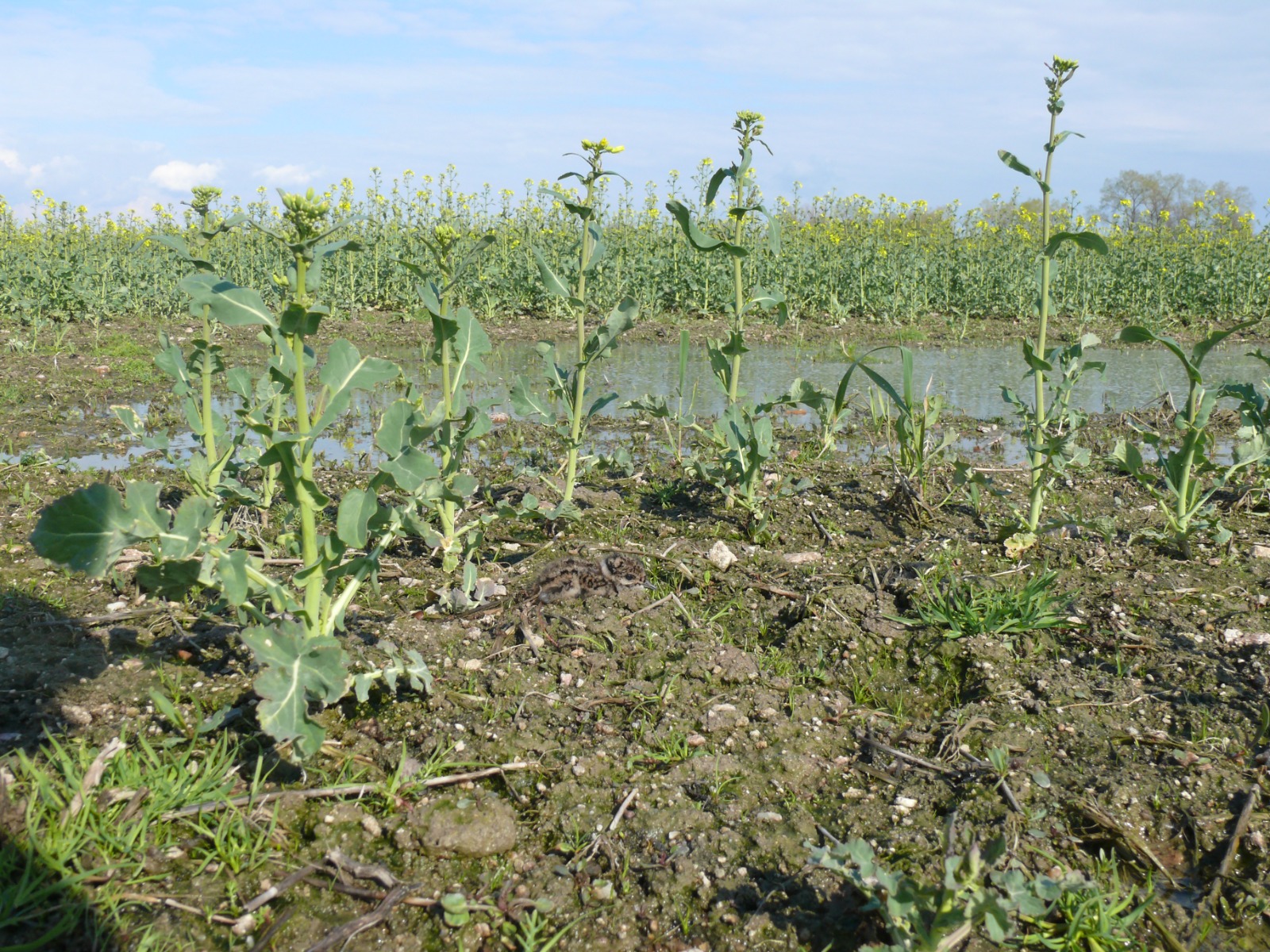
Figure 1: A lapwing chick hidden in a waterlogged patch of a rapeseed field.
Although there was a certain delay in publishing blog posts because other duties kept overtaking us, our attention to the joys and troubles of lapwings has not weakened in the slightest, and we have more than enough material to analyse. Today, however, we will look at the problems faced by our lapwings from a somewhat broader perspective. We will not focus only on our tagged birds, but will look at what we have learned from analysing large datasets available elsewhere on lapwings and their environment. We will be especially interested in what exactly lapwings are looking for in our fields, and how the agricultural landscape is changing from their point of view over time – both during the season and between years.
We obtained records of lapwings primarily from the Avif database, administered by the Czech Society for Ornithology, which has been paying long-term attention to lapwing breeding sites as part of the Northern Lapwing Monitoring project. Thanks not only to this project, it has been possible over the last 12 years to localise information on more than five thousand at least probable breeding sites.
If we need to look at the matter from the other side – that is, if we want to find out what the field looked like where a lapwing was reported – fortunately we no longer have to rely only on our own observations, which of course we would never be able to manage. A whole range of data can be downloaded and, with a little skill, paired with the lapwing occurrence records. For example, thanks to the public LPIS land parcel register, we can learn what was grown on a given plot. The BPEJ catalogue gives us a good overview of local soil conditions. Freely available satellite data, after suitable calculations, can indicate how dense the vegetation was at a given site, or how wet it was, and highly detailed weather data can be obtained in just a few clicks all the way back to 1940. The list of interesting and inspiring datasets available entirely free of charge to everyone could certainly go on, but I think this is enough. In short, we live in interesting times – and for once the word interesting does not need to be put in quotation marks!
A certain methodological obstacle we inevitably encounter when using data from “Avif” is that, although we have many records of where lapwings were present, we have no proof of localities where lapwings were absent. The fact that no lapwing observation exists in Avif for a given field does not necessarily mean that lapwings did not occur there, or even that they did not nest there in a numerous community. It may simply be because no observer visited the site, noticed the lapwings, or considered the observation interesting and worth recording enough to share it with us. We therefore had to find a way to deal with this problem as well. For each locality (field) where we had confirmed lapwing occurrence in a given year, we randomly selected ten additional fields, in such a way that fields located in places more frequently visited by observers had a higher probability of being selected. In other words, places from which more observations had been entered into Avif in that season (of any species – not only lapwings). Even so, we cannot guarantee that these are fields without lapwings. But we maximise the chance that such fields will truly predominate in the control group – and that, on average, they will represent sites that lapwings do not like very much.
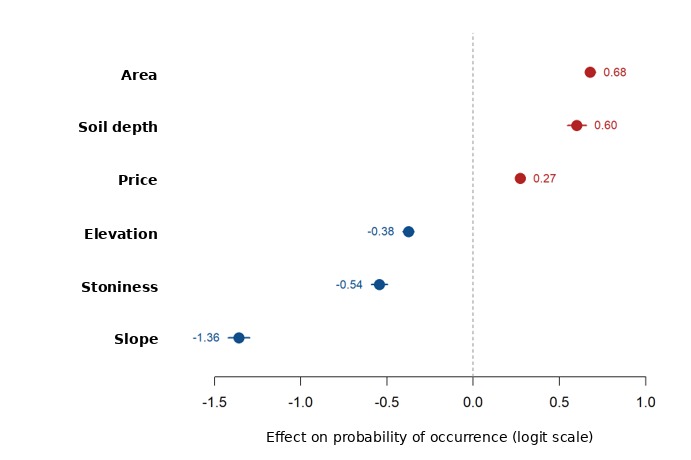 Figure 2: Probability of lapwing occurrence according to field characteristics. Positive values (red) indicate traits that increase the probability of lapwing presence, while negative values (blue) show which fields lapwings tend to avoid.
So what kinds of fields do lapwings like? Briefly, this can be summarised as follows: they need large, flat fields at lower elevations, with deep soil, ideally not too stony (in this respect they differ from Little Ringed Plovers), and – perhaps surprisingly – also expensive ones (Figures 2 and 3)! Of course, the price is somewhat misleading (lapwings usually do not check LPIS), but only somewhat. Price is correlated with other soil properties that both humans (expecting high crop yields from them) and lapwings (craving plenty of fat earthworms and other food) can appreciate. Unfortunately, this does not bode well for lapwing conservation – no one will be eager to adjust their farming for lapwings at the expense of their own yields exactly where they can hope for the best harvest. Nevertheless, let us look at the whole problem in a little more detail.
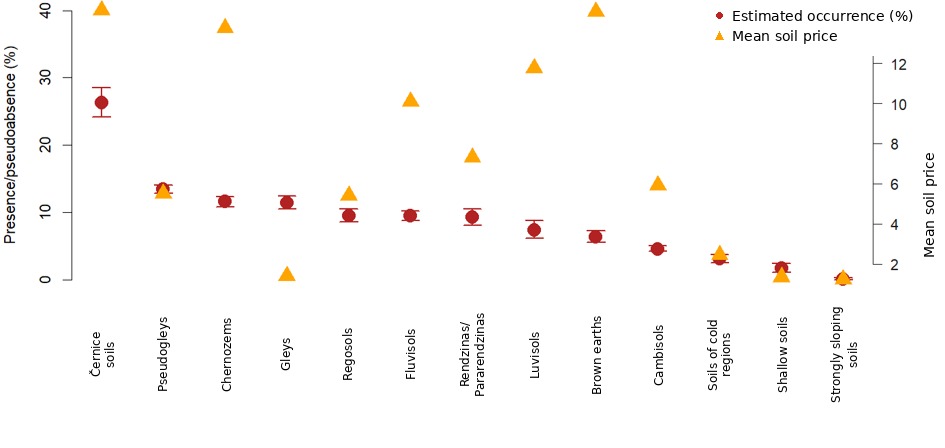 Figure 3: Probability of field selection by soil type. The red dot marks the estimated probability of lapwing occurrence; the yellow triangle indicates the average price of that soil type.
Looking at Figure 3, we can compare the probability of lapwing occurrence on different soil types with their average price. What immediately catches the eye is the strong preference for chernic soils – one of the highest-quality and also most expensive soil types. Lapwings clearly love them! More than a quarter of the included plots with chernic soils belonged among those with lapwing observations – and let us again remember that the large group of control plots undoubtedly also includes many that were in fact occupied by lapwings, but no one entered a record of them into Avif. When listing the other soil types, we are already much closer to the boundary of roughly nine percent – that is, the proportion of plots with lapwing occurrence and therefore a proportion indicating neither preference nor aversion to a given soil type. Even so, we can still detect statistically significant differences in the preference for other soil types. Besides expensive chernic chernozems, lapwings also like relatively cheap Stagnosols and Gleysols – soils typical of significant waterlogging. By contrast, they tend to avoid (also expensive) Luvisols.
Anyone who enjoys watching nesting lapwings will of course have noticed that the set of arable-field properties discussed so far leaves out what is probably the most important one – the crop grown on the plot in that year. We do not need large datasets or sophisticated statistical models to notice that a lapwing needs low and/or sparse vegetation, through which it can move freely (ideally even with tiny chicks), and which does not prevent it from keeping watch for approaching predators. Large datasets and sophisticated statistical models are, however, quite useful if we want to describe precisely what lapwings consider an “acceptable” vegetation density. Here, however, the key point is not the exact value that a lapwing accepts for nesting (should anyone happen to be interested, it is an NDVI of roughly up to 0.45). More importantly, such an indicator allows us to map how the availability of vegetation of this “acceptably dense” kind changes through time and space.
Probably no crop can host lapwings throughout the entire season. The longest time they can remain is in fields sown with soybeans (which are the absolute winner in this respect – see Figure 4, maize, or sugar beet. It is only necessary to remember that lapwings often start nesting in these crops early in the season, when the field is still bare ploughland. And if their nest is not found and marked with sticks, most first attempts on such plots do not end well. Some spring cereal stands may therefore be more advantageous for first nesting attempts (Fig. 4), provided that the chicks then have somewhere to move. Conversely, the figure shows that winter crops are in most cases unsuitable for nesting, even at the beginning of the season. They can, however, serve well as places to which lapwings move after breeding, at a time when even late and slow-emerging crops begin to form tall, dense stands that lapwings can no longer inhabit.
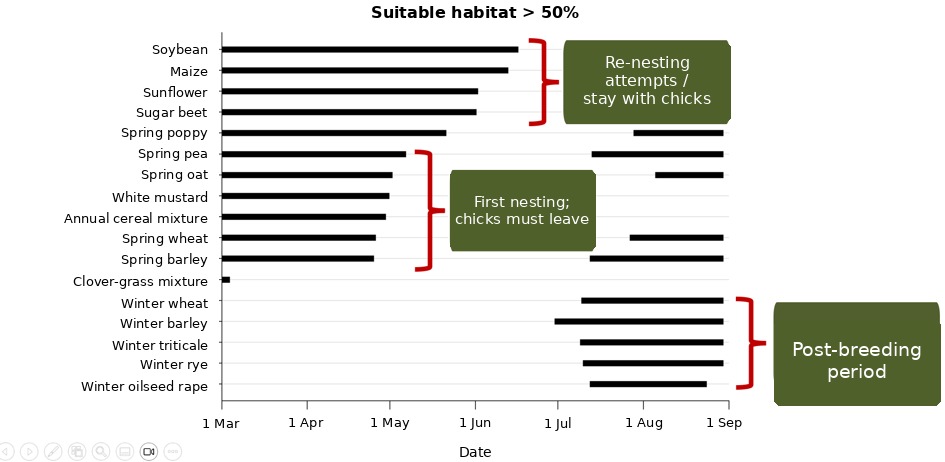 Figure 4: Suitability of individual crops for the lapwing throughout the nesting season. Black bars indicate a probability (>50%) that the crop suits lapwings during that period.
An even broader perspective can also be interesting. We live at a time of frequently discussed climate change; year after year we feel that spring starts earlier and winters are warmer. And agriculture, of course, is changing too. Emphasis is placed on precision farming, efficient timing of operations, and the use of high-yield cultivars. The composition of crops is naturally changing as well. How does all this translate into the life of the lapwing and into the availability of suitable habitat it needs for nesting?
In Figure 5 you can see how the availability of suitable (i.e. not too overgrown) areas in the agricultural landscape develops during spring. The difference between the two curves is not specific to the particular years shown, but reflects a statistically significant trend (shift) in mean values that has occurred over those 12 years. For lapwings, the most important change is the difference between the two curves in April and May. It means that the window of opportunity that lapwings use here is closing faster and faster. Over those 12 years, the lapwing has, on average, lost about five percent of arable land, which has reduced its living space by roughly one fifth. If we look at where lapwings nest, over the same period we can mainly observe a decline in early breeding sites in winter cereals and oilseed rape – these are simply now already too tall for lapwings to move in at all.
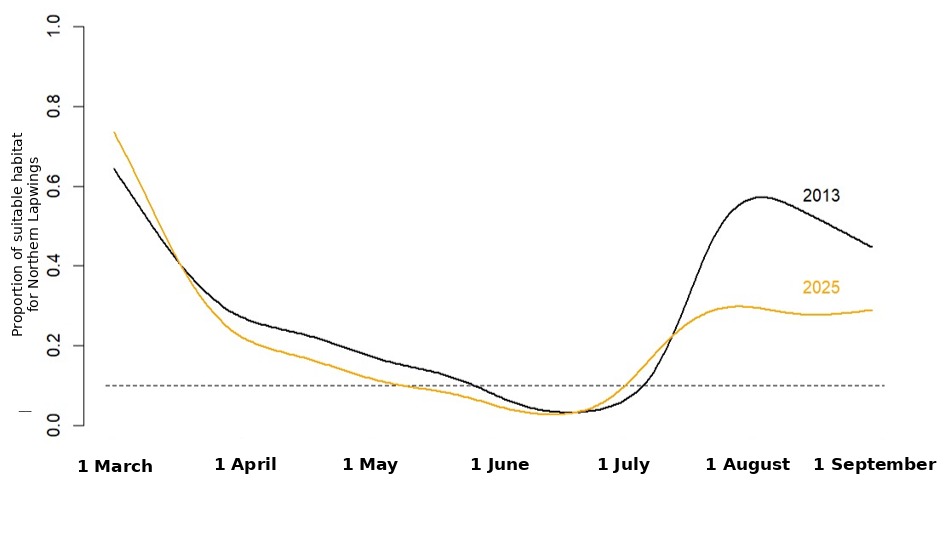 Figure 5: Proportion of suitable habitat for the lapwing throughout the year, comparing 2013 (black line) and 2025 (yellow line).
The second potentially important change for lapwings over the last 12 years is the somewhat earlier start of harvest. In theory, this could shift forward (or possibly reduce) the first wave of lapwing departures to France, which we expect any day now! Unfortunately, we do not have the data to confirm this assumption – that is, precisely dated departures of tagged lapwings – and we are unlikely to have them any time soon. And with the expectation of the first departures, we will now leave the lapwings for today. In future texts, however, we will return to them and continue the topic begun today: the analysis of freely available data. We believe that by analysing all available datasets, we will manage to find a way to improve, at least a little, the rather gloomy prospects that lapwings currently face in today’s landscape – as is also evident from the breeding success of our transmitter-tagged friends.
Graph 4