
Another year has flown by, and just like last year our lapwings left their breeding grounds toward the end of the year to escape the Central European winter and spend it in milder parts of western and southwestern Europe. During last January’s trip through France we got a fairly clear picture of how our lapwings spend the winter in these closer destinations – from the attractive area around Champagne to the French Atlantic coast. And as so often happens, new findings immediately sparked new, nagging questions. What is it like further south? Is it similar there? Do lapwings also gather in large flocks scattered across wide fields with ploughed land, stubble, winter crops and other farmland? Do they change sites during the day? Can they even be found and seen during daylight? Are there more or fewer of them compared to France? Southern Spain is, after all, a noticeably warmer landscape, full of vast steppes and pastures. Does this make any difference to how wintering lapwings behave?
The plan to follow our wintering lapwings to Spain took shape toward the end of last year, when we also set the travel dates – from 9 to 15 January 2026. This time we had to get close to the target areas by plane. That didn’t go entirely smoothly, as heavy snowfall over Prague caused a six-hour delay, but from the calm streets of Madrid we continued by a rented car, visiting lapwing sites according to our rough itinerary (Figure 1). We started with a short field check about 100 km northwest of Madrid, in the wider area around the town of Arévalo in the province of Ávila. From there we headed 230 km southwest to the vast province of Extremadura, where the historic town of Cáceres became our base for several days of trips both nearby and farther afield . As last year, besides searching for marked birds we planned to count and observe lapwings as much as possible, so we could compare our experiences and observations with the situation in France. As will become clear later, even this seemingly simple goal turned out not to be easy at all.
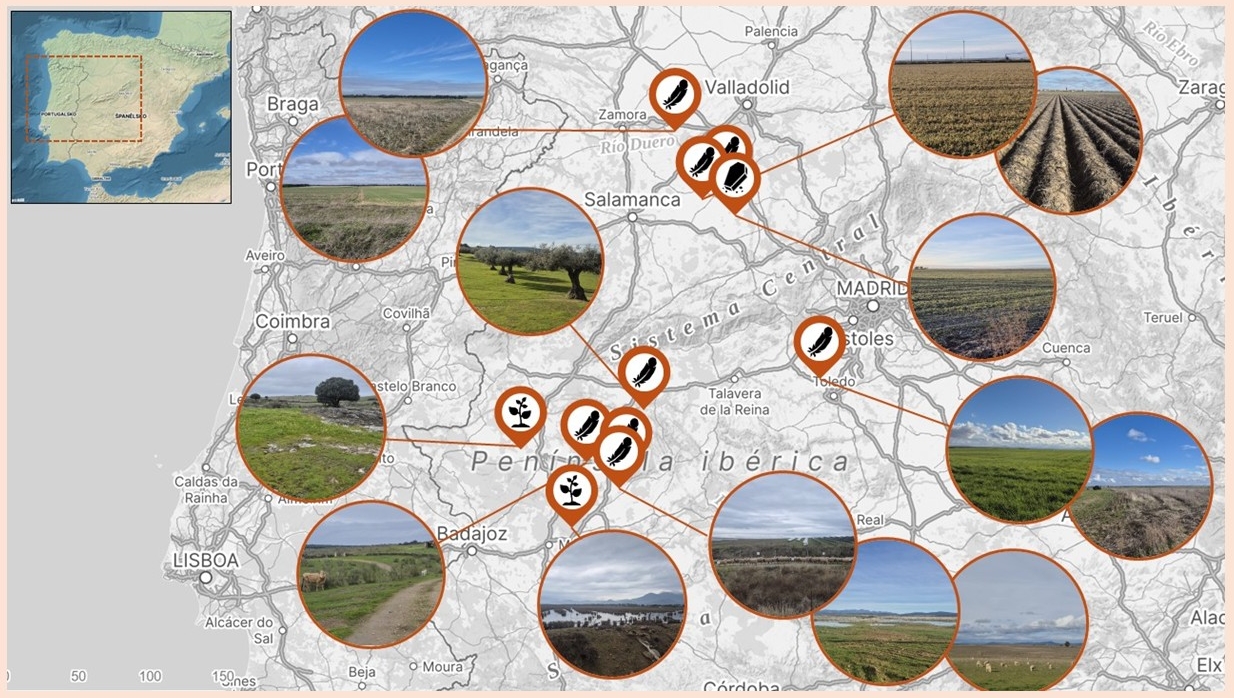 Figure 1: Map showing habitats where our wintering lapwings were present.
Investigating Uherák’s death
Much like last year, we began our fieldwork with the least cheerful task: trying to locate a transmitter that had stopped working on 24 November 2025. Its ominously fixed position over the last few days clearly suggested the end of its wearer’s journey – a male lapwing named Uherák, caught on the nest on 9 April 2025 near Staré Nechanice. In the end, we did manage to complete this task, which we count as a success after last year’s failures (Figure 2). After carefully searching every inch of a five-metre strip of slightly frozen ground along a farm track at the edge of a winter crop field, right at the spot where the last signal had been sent 46 days earlier, we finally found the unlucky transmitter of the even unluckier Uherák, hidden under sparse remains of dry, frost-covered vegetation.
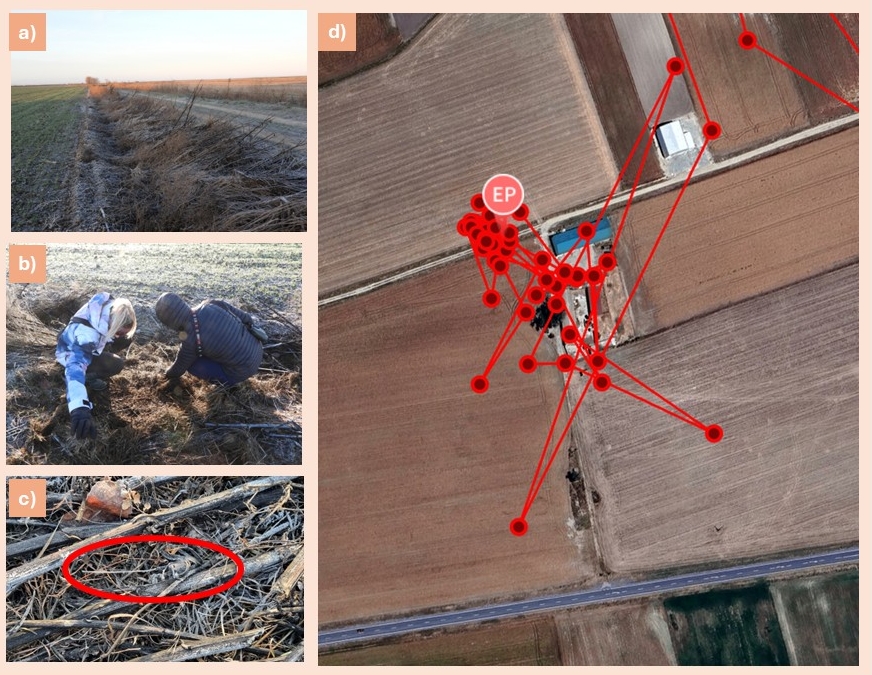 Figure 2: a) Last location of the male Uherák – ditch along the field, b) searching for the transmitter at the given locations, c) transmitter found in the vegetation, d) map of the last locations of the Uherák's transmitter.
Our experiences from France last year warned us against too much optimism when it came to our next ambition – shining in a fresh case of “forensic telemetry” and reconstructing the immediate cause of Uherák’s death from this single find. Still, we tried to come up with at least a tentative conclusion. Likely puncture marks from talons on the harness straps of the transmitter, and on the other hand a complete lack of tooth marks like those we had previously seen on transmitters found in the Czech Republic, pointed us toward the idea that the predator was most probably a bird of prey – perhaps a goshawk or a falcon. It likely killed its prey somewhere in the surrounding fields, then processed it elsewhere and, once fed, left the remains of the meal, transmitter included, to their fate. The leftovers were later taken care of by another opportunistic scavenger, perhaps a small mustelid, which carried them a short distance away, where the transmitter separated from what was left of the skeleton. This would best explain the absence of any traces or feathers at the place where we found it. All in all, this is a fairly expected scenario, given that both of the mentioned raptors are common in the area and readily prey on lapwings if they get the chance. And in this landscape, that chance comes quite easily, judging by the number of lapwings in the wider surroundings: that day we counted 860 birds in 23 groups, with an average of 30 and a maximum of 270 individuals in a single flock. Those are numbers hard to miss even for a human – let alone a hungry raptor.
The agricultural landscape of north-western Spain
Among the lapwings in the heavily farmed landscape of the Ávila region there were also two living candidates we were hoping to find – Čalamáda, caught on 23 April 2025 near Syrovátka in the Nechanice area, and Yehla, marked on 11 April 2025 near Jehlice in the same region. So, once the Uherák case was closed, looking for these two females was the obvious next step. Their recorded positions from the previous morning, just a few kilometres apart in what looked like fairly open farmland, gave us plenty of hope. That hope paid off only in Čalamáda’s case. We found her relatively quickly in a flock of about 60 lapwings, loosely spread along the edge of a large field with sparse remains after the harvest of fodder beet. There she was feeding in a small group together with other lapwings (Figure 3). We were lucky, because the field sloped gently down toward a firm farm track, which allowed us to approach the birds slowly to within about 300 metres. From the calm shelter of the car we could then comfortably check one bird after another. This was a clear advantage, as frequent gusts of cold wind made it hard to watch the birds steadily through tripod-mounted scopes, which had to be set up outside the car and therefore too far from the cautious birds.
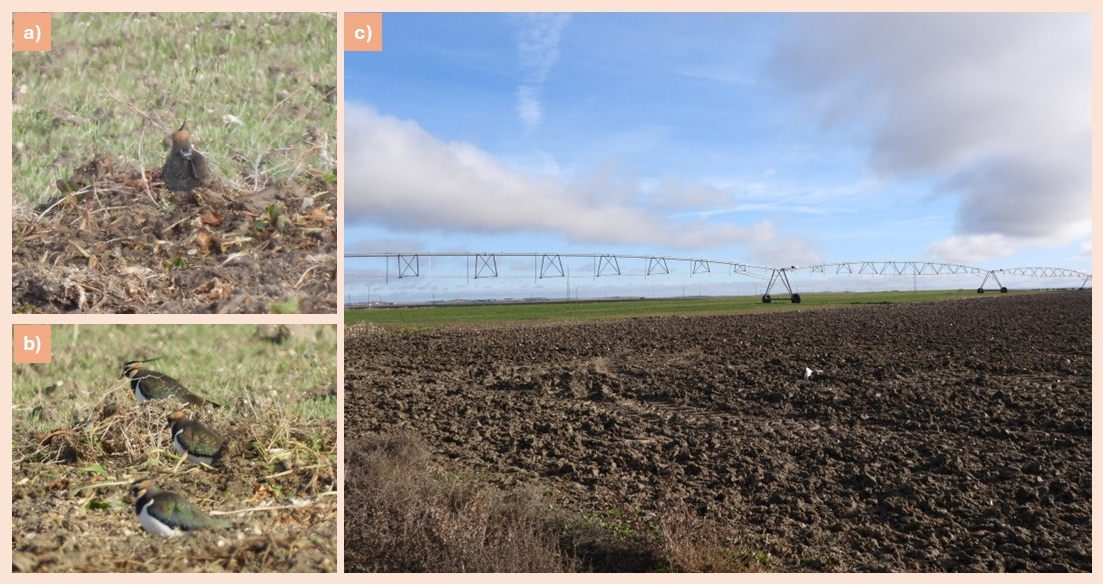 Figure 3: a) Lapwing Čalamáda with visible transmitter, b) Čalamáda in a flock with other lapwings, c) field where Čalamáda was found.
Unfortunately, we didn’t have the same luck with Yehla. Although it was more than likely that she was staying in one of several smaller flocks of dozens of lapwings moving around the area, the field conditions made it impossible to spot her. In places the fields were too uneven, with low rises hiding the birds – you could sense lapwing heads rather than actually see them, let alone backs with transmitters. Large sections of the fields were also covered in ridges with dried-up potato haulm, in which the lapwings could hide remarkably well. Walking through these fields, flushing one lapwing after another and trying at the same time to spot a transmitter on their backs, was simply beyond our limits.
The lapwings wouldn’t let us get too close, not even with a slowly moving car – let alone on foot. As soon as we tried, the birds would quickly take off and move away, until the whole flock had gradually shifted to neighbouring fields beyond the horizon, or at least beyond the comfortable reach of all our optics. This level of caution, and their perfectly understandable lack of enthusiasm for sharing our joy at seeing them again, was something we would keep running into. And it was going to get worse – but more on that later. All the more pleasant, then, was the character of this farming landscape: large stretches of emerging winter crops, vast ploughed fields and stubble, criss-crossed by a network of well-drivable farm tracks, not unlike the structure of the French countryside. What really stood out was the abundance of uncultivated patches with green or dry wild vegetation, and thus a rich food supply for seed-eating birds. Whether in the form of fairly large fallow blocks or heavily overgrown field margins, this was clearly reflected in the bird communities. Everywhere we went we came across flocks of actively feeding linnets, goldfinches, corn buntings, skylarks and other small passerines, usually numbering in the dozens and occasionally even around a hundred birds. Above us, red kites, common kestrels, western marsh harriers and hen harriers were constantly passing by, as if to underline just how diverse the mix of wintering bird species can be in a typically farmed landscape of southern Europe’s interior.
The picturesque pastures of Extremadura
The landscape we had been seeing so far, largely similar to that in France, changed over the following days after we drove about 250 km south-west to the already mentioned town of Cáceres in the province of Extremadura and dropped some 400 metres in altitude from around 800 m above sea level. The clear dividing line was the high mountain range known as the Sistema Central – impressive both for its nearly 300-kilometre east–west span and for its snow-covered peaks rising to well over 2,000 metres above the surrounding countryside. Even a look from above, using aerial or satellite images of the farmed land in both provinces, reveals one major difference between them. Much of Ávila province looks like a patchwork of countless colourful pieces with sharp edges – a mosaic created by intensively farmed fields of different crops, neatly fitting together and cut through by a dense network of roads and tracks. Around Cáceres, this kind of landscape is much less common. From space, the Cáceres area looks noticeably more monotonous: large stretches of uniform brown, broken only here and there by clusters of khaki dots or patches and vague, winding lines. On the ground, though, this “boring” view turns out to be something quite different. It is made up of vast areas of beautiful pastureland in gently rolling terrain, dotted with greenish pools of small reservoirs, scattered trees and shrubs, weathered boulders, small rocky outcrops, and meandering channels of streams that are partly or completely dry. Dirt tracks snake their way through the pastures and disappear into the distance, adding to the sense of open space and quiet that defines this landscape.
We took to this calm, beautiful landscape right away. And it’s hardly surprising, since our very first trip in the area led us to the protected steppe zone of Llano de Cáceres, where birds in particular enjoy special protection. Alongside great and little bustards, sandgrouses and singing calandra larks – species closely tied to steppe habitats – we were, of course, also keeping a close eye out for lapwings. They were present here too, naturally, in their dozens, but spread out individually across the vast pastures among grazing cattle and sheep, as far as our trained eyes could see. And it was here that we first ran into a major problem that would limit us for the rest of our stay in this promised land: fences running for kilometres along the roads, clearly marking private land with no access allowed. How do you count lapwings beyond the nearest horizon, a few hundred metres away, when the birds are obviously there but you simply can’t see them? Now and then some lapwings seemed to tease us, briefly revealing their dark crests bending in the wind, only to vanish again behind the horizon for a long while. Every attempt at counting ended with a completely different number, so the only sensible solution was to stick to rough estimates, rounded to the nearest ten.
A frustrating game of hide-and-seek
The greatest sense of helplessness, though, hit us while searching for Májka and Cirkulárka. During our stay, both lapwings had settled in pastureland about 5 km apart in the wider area around the village of Torrecilas de la Tiesa near the town of Trujillo, where the gently rolling pastures are cut by the pretty, winding streams of the Río Almonte and Río Tozo. Májka’s positions from previous days showed her fondness for a shallow, wide-open valley of a narrow stream, with small flooded patches lined by dense wetland vegetation and followed by slightly waterlogged pastures stretching as far as the eye could see. And there, behind a fence, among flocks of sheep and cattle – undoubtedly in the company of other lapwings, as there were again many dozens spread across these vast areas – Májka was enjoying her winter peace, about a kilometre beyond the horizon. Judging by the abundance of other birds, especially starlings and skylarks feeding all around, she was certainly not short of food, and human disturbance in these largely empty landscapes was even less of an issue.
And Cirkulárka? She played it even more cleverly, as if making sure we wouldn’t be tempted to ignore the no-entry signs. Her transmitter repeatedly reported her presence just beyond the nearby horizon, at the edge of a large sheep pasture that was additionally shielded by a photovoltaic park surrounded by double fencing topped with barbed wire and covered in very explicit warning signs (Figure 4). There was nothing we could do. So we at least tried to piece together the story of her stay there. She had found this unusual spot among densely packed solar panels, where she could spend her days undisturbed, occasionally flying across the road in the early morning to another part of the park with small wetlands, no doubt to vary her diet. It was without question the most unusual – and the smallest in area – lapwing wintering site we encountered on our entire trip.
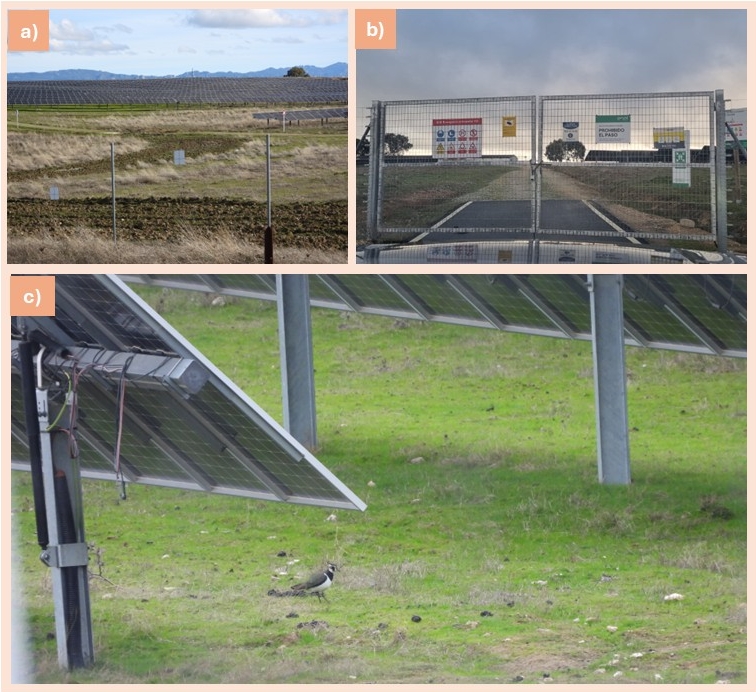 Figure 4: a) the Planta Fotovoltaica Torrecilla solar power plant complex, b) closed access to the site where the Cirkulárka was likely to be found at the time, c) a lapwing in the unusual setting of solar panels.
Female Oliva among olive trees
At least one bird really earned our personal gratitude: the female Oliva, caught already 13 May 2024. She showed herself without any fuss, right away, on a small, partly overgrown pasture near the hamlet of Belvís de Monroy, with the proud medieval landmark of Castillo de Belvís rising above it, close to the town of Navalmoral. She was moving around with a group of about twenty lapwings, and before she and the others flew across a shallow, lightly overgrown valley to the grassy slope opposite, we managed to photograph her from a distance. From across the valley we could then watch her busy running about and steadily feeding (Figure 5). She looked fresh and in good condition. Here too, it seemed that relatively small pastures in broken terrain, surrounded by trees, orchards and olive groves next to a farm and a village, were more than enough to keep small groups of lapwings comfortable through the winter.
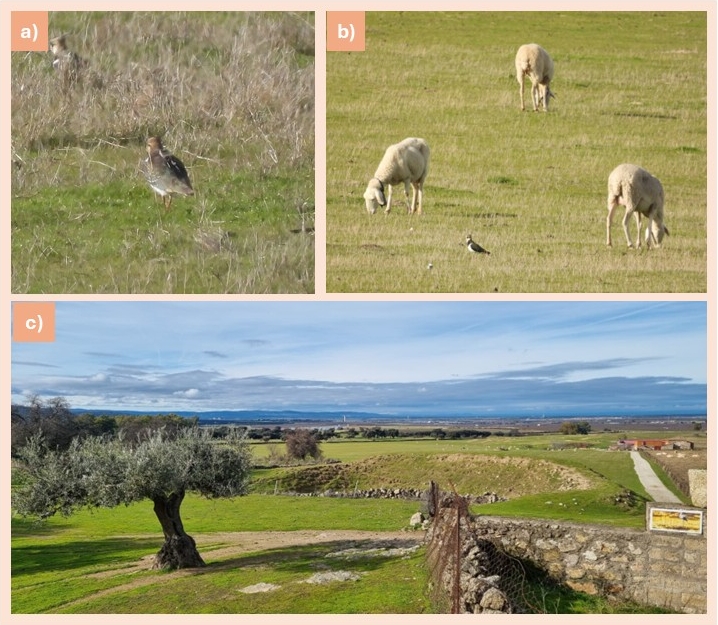 Figure 5: a) Oliva with transmitter at Castillo de Belvis, b), c) other locations where Oliva winters – pastures with sheep.
Oliva also gave us one more interesting insight the following day, when we went to check out her wintering site from the previous year, about 80 km south of this season’s location. Given what we had learned so far, the distance itself wasn’t all that surprising – what really stood out was how completely different the habitat was. The green enclave south of the town of Miajadas, east of Mérida, lying in a fertile lowland along several rivers, is clearly a very warm area and a vegetable grower’s paradise (Figure 6). It is also a paradise for wintering common cranes: we counted more than a thousand of them there. As we drove slowly between fields and small plots along straight irrigation canals, we saw people harvesting broccoli by hand, a flowering field of oilseed rape, plots of cultivated stinging nettle, and orchards full of ripening mandarins. Of course, there were also maize stubbles and ploughed fields, with the occasional lapwing or golden plover hiding away, but no large numbers to speak of. It was an interesting region, completely different from the surrounding world of endless pastures – and one that lapwings seem to use only sparingly. If it hadn’t been for Oliva’s whim last year, we probably would have passed it by without a second glance.
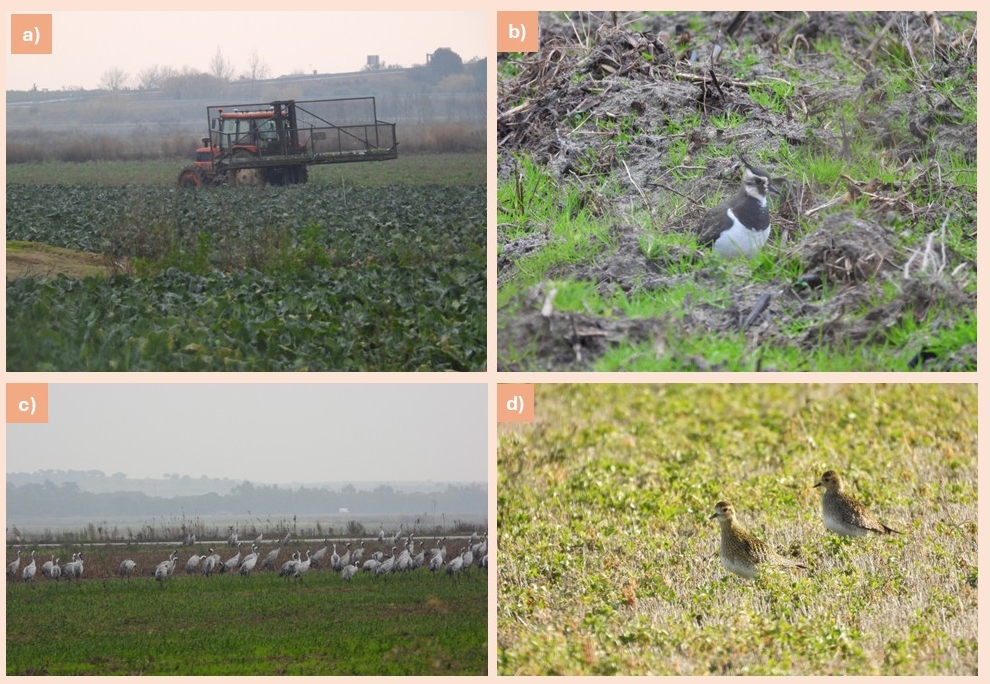 Figure 6: a) Broccoli field in the Oliva occurrence area in February 2025, b) A small number of lapwings were also spotted here, c) A paradise for wintering common cranes, d) Golden plovers are frequent companions of lapwings.
Why Spain?
So it ’s time to sum up what we learned on this short trip and try to compare Spanish wintering grounds with those in France, as we set out to do at the beginning. Perhaps the biggest surprise was that on pasture-based wintering sites, lapwings don’t gather in tight flocks like they do in landscapes dominated by alternating fields. Instead, they are often spread out, sometimes almost individually, but usually still within sight of one another, scattered across seemingly endless plains. They also appear calmer here, no longer forced to take off every few minutes because of passing cars and then move as a flock to another, more distant feeding site. These pastures feel peaceful at first glance and seem to offer food more or less everywhere, so daily movements tend to be limited to short flights by individual birds.
When it comes to numbers, though, comparisons are difficult. Our total estimate of around 1,700 lapwings counted can hardly reflect reality, for two main reasons. First, most of the land visible from the roads we used for observation was hidden behind countless small horizons in the vast, fenced pastureland, with many lapwings likely staying out of sight beyond them. Second, the birds were not gathered in clearly defined flocks that could be counted easily. They were simply everywhere among sheep and cattle – but spread thinly. Given the sheer extent of pastureland in Spain, the real numbers could well be in the many thousands.
Despite this frustrating uncertainty at the end, we believe that none of the Spanish sites we visited holds as many wintering lapwings as the area of eastern France around Champagne that we visited last year. This suggests that our lapwings prefer the closest possible wintering grounds, as long as those places offer decent conditions for getting through the winter. But once those areas become crowded, and the birds tire of constantly moving around in packed flocks and competing for every earthworm with grumpy neighbours, nothing stops them from flying a few hundred kilometres further south. They can afford to do so because, as it seems, they are not strongly tied to a particular wintering site or even a specific type of habitat, unlike some other wader species with a much more conservative nature.
And if Spain is where they end up, there’s good news. As long as pastures continue to be maintained on such a large scale as they are today, there’s no need to worry about the future of wintering lapwings here. There is plenty of space, and they will always find comfortable places to spend the winter – whether peacefully among grazing herds far from people, or in more unusual corners beneath solar panels. And most of them, as we now know, will make it through the winter in good condition, ready to return in time and at full strength to their breeding grounds in eastern Bohemia.